Uhuru Peak
Uhuru Peak
Uhuru Peak, 5,895 m, is the highest point of Kilimanjaro and Africa. Routes, duration, seasons and access from Moshi and Arusha.
Uhuru Peak is the highest point of Mount Kilimanjaro and Africa, standing at 5,895 meters above sea level. Located on the volcanic cone of Kibo, it bears a Swahili name — Uhuru, "freedom" — which commemorates the independence of Tanganyika in 1961. Reaching this summit requires several days of high-altitude trekking through five successive ecological zones, from coffee plantations to remnant glaciers.
Why climb Uhuru Peak
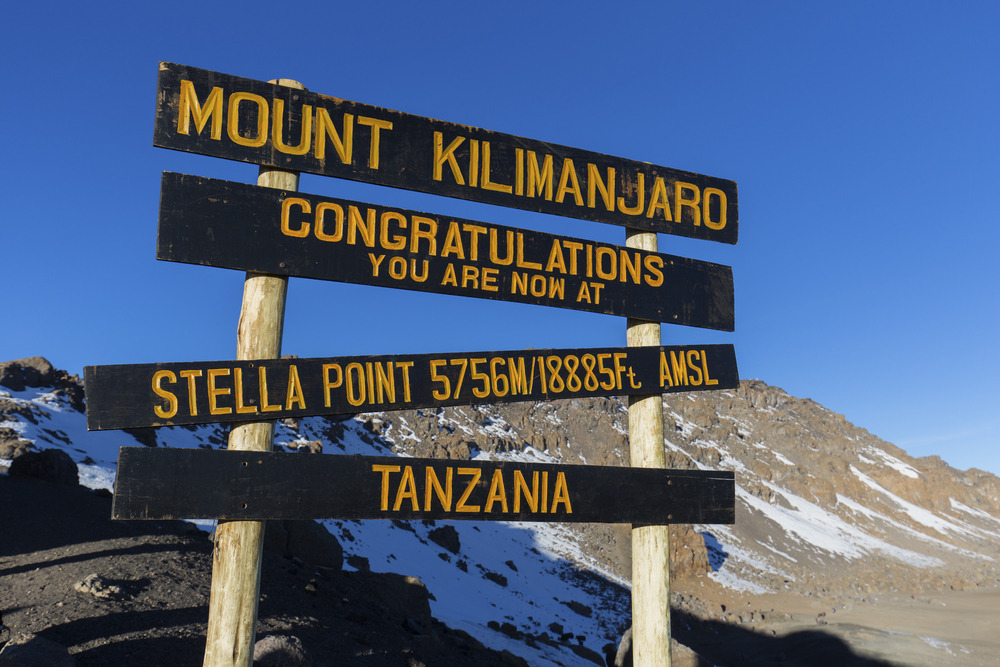
Uhuru Peak appeals to climbers for three main reasons. First, its altitude: it is Africa's highest summit and the world's tallest free-standing volcano. Second, the progressive trekking experience from a tropical zone to equatorial glaciers, compressed into just a few days. Third, its symbolic significance: the summit was renamed in 1961 to mark the country's independence, and the wooden sign fixed in place still bears the official inscription:
"CONGRATULATIONS - YOU ARE NOW AT UHURU PEAK, TANZANIA 5895M - AFRICA'S HIGHEST POINT - WORLD'S HIGHEST FREESTANDING MOUNTAIN - ONE OF THE WORLD'S LARGEST VOLCANOES - WORLD HERITAGE AND WONDER OF AFRICA"
Next to the sign, a wooden box contains a logbook where climbers leave a message after their ascent.
History: from Kaiser-Wilhelm-Spitze to Uhuru Peak
The first documented ascent dates back to October 6, 1889, by German alpinist Hans Meyer and Austrian guide Ludwig Purtscheller. Meyer named the summit Kaiser-Wilhelm-Spitze, after German Emperor Wilhelm II. Tanganyika was then a German colony; it came under British mandate after World War I, following the Treaty of Versailles.
The colonial name persisted until Tanganyika's independence on December 9, 1961. The summit was renamed Uhuru Peak, from the Swahili word uhuru (freedom). The day before the official date, Brigadier Alexander Nyirenda hoisted the Tanzanian flag at the summit and planted the Uhuru Torch, a torch intended, by all accounts, to "light Africa where there is darkness." At the same moment in Dar es Salaam, the Union Jack was lowered. Since then, Uhuru Peak has functioned as a site of national memory as much as a climbing objective.
What you traverse during the ascent
The climb of Kilimanjaro traverses five ecological zones arranged by altitude:
- Cultivation zone (800–1,800 m): cornfields, coffee and banana plantations around Moshi.
- Humid tropical forest (1,800–2,800 m): dense canopy, colobus monkeys and chameleons, heavy rainfall.
- Moorland and heath (2,800–4,000 m): sparse vegetation, tree heathers, clear views of neighboring volcanoes.
- Alpine desert (4,000–5,000 m): mineral landscape, giant groundsels and lobelias, wide temperature swings.
- Arctic zone (above 5,000 m): glaciers, permanent snow, temperatures dropping to -20°C.
Kibo, which holds Uhuru Peak, is one of three summits in the massif, alongside Mawenzi (5,149 m) and Shira (3,962 m). Stella Point, at 5,756 m on the crater rim, is the key staging point from which climbers typically witness the sunrise before reaching the summit.
Routes and duration
Seven main routes lead to the summit, with durations ranging from 6 to 9 days depending on the path:
- Marangu ("Coca-Cola"): the shortest, with hut accommodation.
- Machame ("Whisky"): popular, more challenging, varied scenery.
- Umbwe: the steepest and most direct.
- Lemosho and Shira: western approach, good acclimatization.
- Northern Circuit: the longest, high success rate thanks to gradual acclimatization.
Most climbers progress slowly to acclimatize. For reference, Ecuadorian mountaineer Karl Egloff holds the round-trip speed record in approximately 6 hours 42 minutes (set in 2014). The descent typically passes through Mweka camp on the south slope.
Practical preparation
The ascent requires no alpine technical skills, but good physical fitness and proper altitude preparation. Acute mountain sickness is the primary factor in failure, more so than steepness itself. A few guidelines:
- Choose a route of at least 7 days to promote acclimatization.
- Pack gear suited to temperature swings from +25°C to -20°C: technical layers, down jacket, windproof trousers, warm gloves, headlamp.
- Accompaniment by an authorized guide and porter team is mandatory within the national park.
- Park entry permits and fees are included in packages offered by local operators; budget generously for each day spent in the park.
- Continuous hydration (3 to 4 liters/day) and carbohydrate-rich food.
When to go
Two windows are recognized as most favorable:
- January to mid-March: often clear skies, mild temperatures at lower altitudes, moderate crowds.
- June to October: dry season, stable conditions, peak season on the mountain.
Rainy seasons (mid-March to May and November) make forest trails muddy and nights colder above 4,000 m; however, they offer less crowded trails.
How to access Kilimanjaro
The usual entry point is Kilimanjaro International Airport (JRO), served by several flights from Europe and the Middle East. The towns of Moshi (approximately 45 km away) and Arusha (approximately 1.5 hours' drive) serve as logistical bases: most operators organize briefings, equipment, and transfers to park gates (Marangu Gate, Machame Gate, Londorossi Gate depending on the route) from these locations.
What to combine in the region
Many travelers extend their climb with a safari on the northern circuit. Within reasonable proximity:
- Arusha National Park, ideal for an acclimatizing warm-up on Mount Meru.
- The Ngorongoro Conservation Area, whose crater concentrates dense wildlife.
- Ol Doinyo Lengai, an active volcano to the north, for climbers seeking another summit.
- Lake Natron, an alkaline lake known for its lesser flamingos.
FAQ
Frequently asked questions
It varies significantly depending on the route and its duration. Short 5-day routes sometimes show success rates below 50%, while 8 to 9-day itineraries (Lemosho, Northern Circuit) often exceed 85% thanks to better acclimatization.
No. No rope work or climbing technique is required on standard routes. It is a long high-altitude trek. The main difficulty is physiological, related to hypoxia above 4,000 m.
Uhuru Peak stands at 5,895 meters. It is the highest point of Kilimanjaro, Tanzanie, and the African continent.
Yes. Kilimanjaro is a national park managed by TANAPA. Entry, use of camps, and accompaniment by an authorized guide are mandatory. These fees are systematically included in operators' packages.
Preparing your ascent
To incorporate Uhuru Peak into a complete itinerary combining trekking, safari, and cultural experiences, consult our trips to Tanzanie designed with our local partners.
Interested in this visit?
We can include it in your personalised itinerary.