Shira Camp
Shira Camp
High-altitude bivouacs on the Shira plateau, key stages on the Lemosho and Machame routes to the summit of Kilimanjaro.
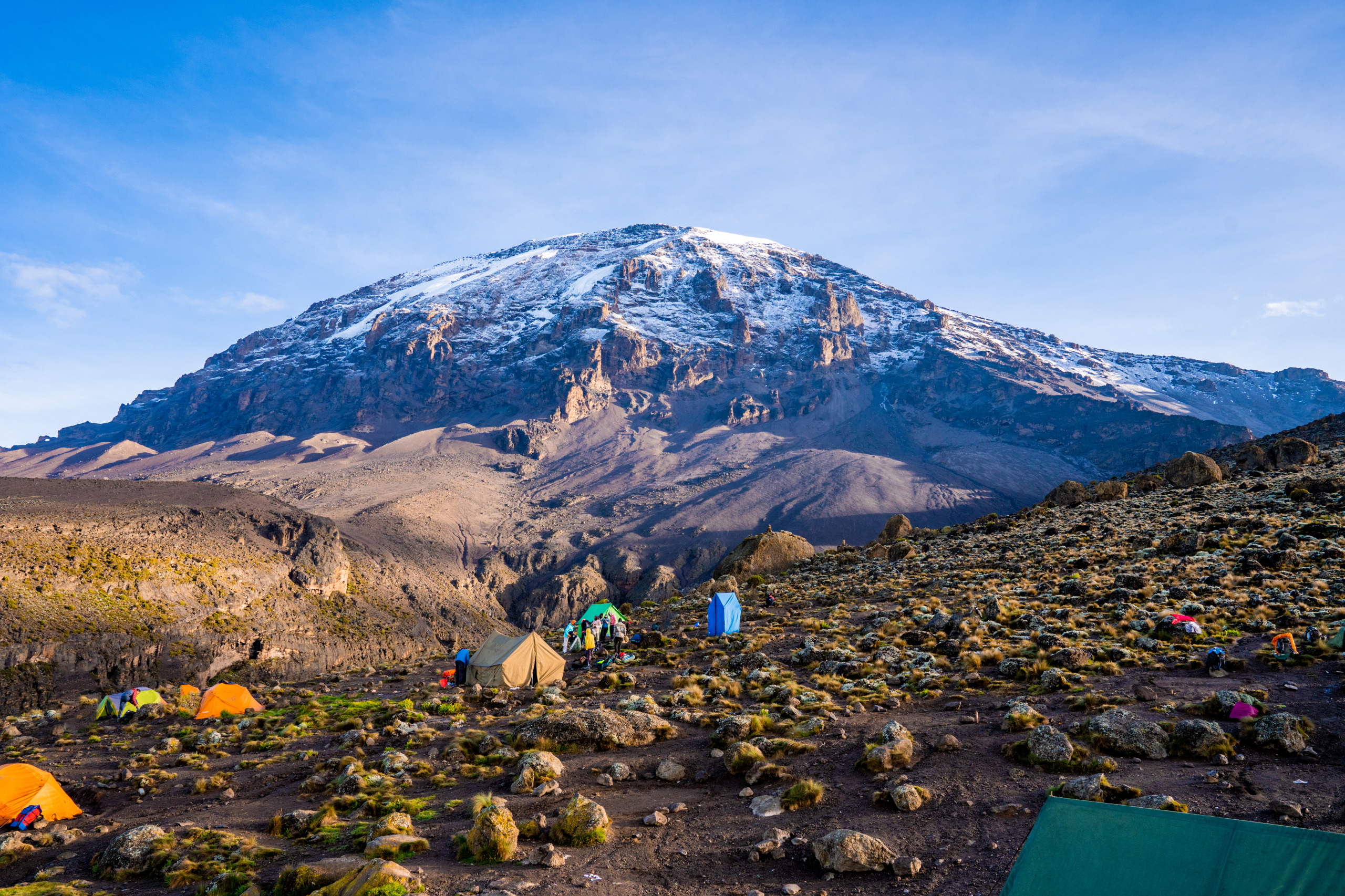
Shira Camp refers to two successive bivouacs established on the plateau of the same name, on the western flank of Kilimanjaro. They serve as acclimatization stages for trekkers on the Lemosho, Shira and sometimes Machame routes, before progressing to the higher camps and attempting the summit.
Why stop here
Shira is not a lodge but a high-altitude canvas camp, set up each day by the teams of authorized operators. Its appeal lies in its position: the Shira plateau is one of the oldest volcanic features of the massif, and it marks the threshold between the heather zone and the alpine desert. Trekkers spend one to two nights here depending on the itinerary, which plays a key role in acclimatization and the prevention of acute mountain sickness.
Two campsites succeed one another. Shira Camp 1, at around 3,510 meters, often marks the second day for groups departing from Londorossi Gate via the Lemosho route. Shira Camp 2, at around 3,890 meters, is further east and serves as a relay before continuing the ascent, sometimes preceded by a detour to Lava Tower.
Camp atmosphere
Life at Shira Camp follows the rhythm of the trek. Arrival in early afternoon, individual tents are already pitched by porters who departed earlier; guides and logistical staff share common tents. You drink hot tea, consult the oximeter with your guide, walk a little higher to aid acclimatization, then dine under the mess tent before a short night. Wake-up comes early, in dry cold, sometimes with Kibo still illuminated by moonlight.
Evenings are peaceful: no network signal, little artificial light, and particularly clear skies that make stargazing remarkable when clouds part.
Services and logistics
- Individual tents pitched by porters; common tents for guides and staff.
- Filtered drinking water supplied by the logistical team.
- Traditional wooden latrines scattered across the site and more recent solar toilets, recognizable by their transparent roofs.
- A green wooden cabin, powered by solar energy, located west of the camp and reserved for park rangers.
- Strictly supervised access: certified guides and porters are mandatory on Kilimanjaro.
Location and environment
The camp sits on the Shira plateau, in the ecological zone of heathers and alpine moorland, transitioning to the alpine desert traversed higher up. In clear weather, views extend to the Kibo glaciers to the east and the silhouette of Mount Meru to the west. Vegetation is sparse, dominated by giant heathers and mosses, and fauna is limited to a few high-altitude birds, including the Tanzanian White-eye. Buffaloes can be spotted in the lower areas below, in the park's lower zones.
When to go
Recommended climbing seasons correspond to dry periods: late June to early October, and mid-December to mid-March. Rainy seasons, April to June and November to January, make trails slippery and visibility unpredictable. Whatever the period, nighttime temperatures at Shira Camp range between 10°C and -5°C, with frequent wind: thermal clothing, waterproof jacket and mountain boots are essential.
Neighboring stages on the route
After Shira Camp 2, most itineraries reach Barranco Camp via Lava Tower, then Karanga and finally Barafu Camp, the starting point for the night assault on Uhuru Peak. Before the trek, many groups spend a night in Moshi or Arusha for briefing and logistics. For a gentler approach to the massif via the Marangu route, the equivalent stage is Mandara Hut. For urban accommodations before or after the ascent, several useful options: Parkview Inn, Outpost Lodge or Nsya Lodge for a controlled budget, and the Gran Melia Arusha for a more comfortable stop.
Preparing your ascent
Climbing Kilimanjaro requires preparation several months in advance: choosing your route, physical conditioning, equipment and permits. To build a trip combining trekking and safari, consult our journeys in Tanzania.
Fancy staying here?
We can book this accommodation for you.