Refuge De Barranco
Refuge De Barranco
At 3,950 m on the slopes of Kilimanjaro, Barranco Refuge is a key stop on the Machame and Lemosho routes where afro-alpine vegetation gives way to the first volcanic rock faces.
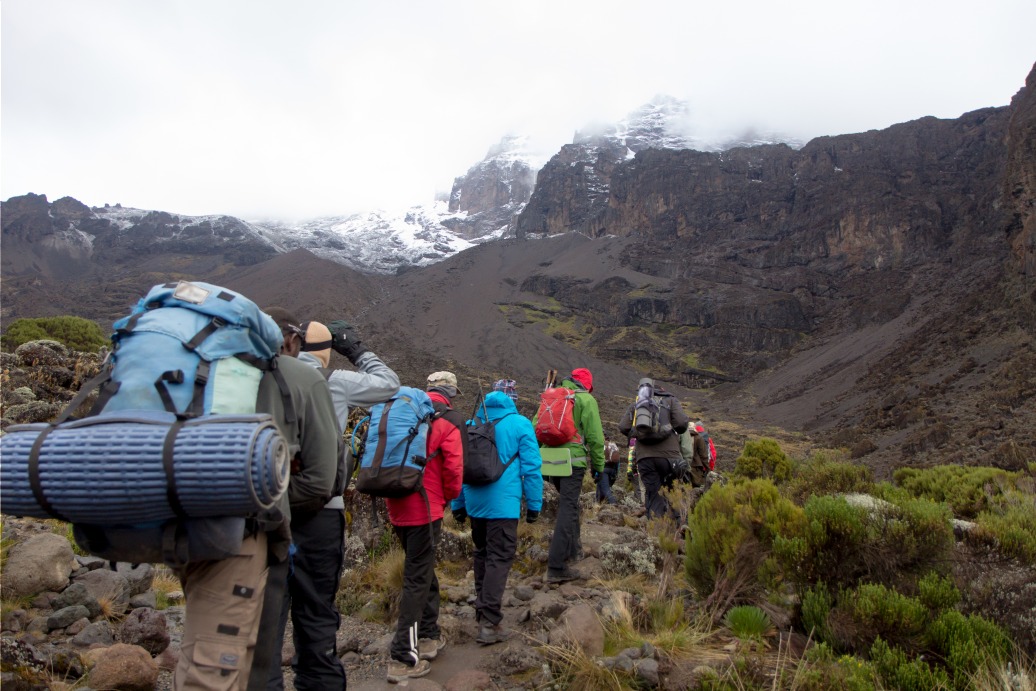
Barranco Refuge sits at approximately 3,950 meters altitude on the slopes of Kilimanjaro, within Kilimanjaro National Park. A key stage on several routes — Machame, Lemosho, and Shira — it marks the junction between the giant heath zone and the first rocky walls of the volcanic calotte. This is where the mountain reveals its alpine character, with the Great Wall of Barranco rising just above the camp.
Quick Facts at a Glance
Altitude: approximately 3,950 m
Access: on foot only, via Machame, Lemosho, or Shira routes
Entry: included in Kilimanjaro National Park entrance fees (paid at park entrance)
Gear: high-altitude trekking equipment mandatory — thermal layers, waterproof jacket, hat
Length of stay: typically one night, before ascending the Great Wall the next morning
Accommodation: camping tents provided by authorized operators; no lodge or fixed dormitory
What You'll See
The camp sits in a sheltered valley, protected from the wind, bordered by giant groundsels (Senecio kilimanjari) and tree-like lobelias. These endemic plants, with their sculptured silhouettes, create a science-fiction landscape. Looking up, the Great Wall of Barranco — a lava cliff several hundred meters high — dominates the camp and hints at the day ahead.
History and Context
Kilimanjaro is a stratovolcano whose activity has carved deep valleys, including the Barranco cirque. The camp became a standard stage as trekking tourism developed in the 1980s and 1990s, when alternative routes to Marangu were mapped and regulated by TANAPA (Tanzania National Parks Authority).
Highlights of Your Visit
The Great Wall of Barranco
The next morning, ascending the wall is the most technical section on Kilimanjaro's non-glacial routes. Progress is made hands and feet over stable rocks, with no climbing gear required. The panorama from the wall's summit, looking down at the camp and valley below, is breathtaking.
Afro-Alpine Vegetation
Barranco sits at the upper limit of the giant heath zone. Groundsels reach several meters in height. Watching these plants at sunrise, covered in frost, is a rare visual experience unique to Kilimanjaro and a few other East African massifs.
Starlit Nights
At nearly 4,000 m, far from any light pollution, the night sky is exceptional. The Milky Way is visible to the naked eye on clear nights. Pack warm clothing: temperatures often drop below freezing after dark.
Photography Tips
Golden sunrise light bathes the Great Wall and giant groundsels — set out early. For altitude portraits, the dark volcanic cliff backdrop contrasts beautifully with green vegetation. During the wall ascent, the sweeping views down to camp are worth pausing for. Protect your camera from nocturnal cold by keeping it close to your body in the tent.
Location and Access
Barranco Camp sits on the southwestern slope of Kilimanjaro, within Kilimanjaro National Park (Kilimanjaro region, northern Tanzania). Moshi, the main departure point for expeditions, lies a few hours' walk from the park's entry gates. Kilimanjaro International Airport (JRO) serves the region.
The camp is accessible only on foot, accompanied by an authorized guide and porter team. Any Kilimanjaro ascent must be organized through a TANAPA-approved operator.
Nearby
Machame Refuge (Machame Camp) — the previous stage on the Machame route, at approximately 3,000 m, within the heath forest.
Karanga Refuge (Karanga Camp) — the next stage after Barranco, in the Karanga valley, before the ascent to base camp.
Lava Tower — volcanic formation at approximately 4,600 m, often visited for acclimatization from Barranco.
Kilimanjaro National Park — protected setting and UNESCO World Heritage site encompassing the entire ascent.
Frequently asked questions
Barranco Camp is a stage on the Machame, Lemosho, and Shira routes. The Marangu route (Coca-Cola route) does not pass through this camp.
No. Ascending the wall is rock scrambling that requires no climbing equipment. It demands balance and comfort with heights, but is accessible to trekkers in good physical condition.
The best weather windows on Kilimanjaro generally fall from January to March and June to October. The main rainy season months (April-May) should be avoided.
There is no lodge or fixed dormitory at Barranco. Authorized operators provide camping tents, mess tents, and cooking equipment. Everything is carried by porters.
Yes. At approximately 3,950 m, nighttime temperatures regularly drop below 0 °C. A sleeping bag rated for sub-zero temperatures is essential.
Yes, photography is permitted throughout Kilimanjaro National Park. Protect your equipment from cold and moisture, especially at night.
Want to discover this destination?
Our local advisors design your tailor-made trip.