Olduwai Gorge
Olduwai Gorge
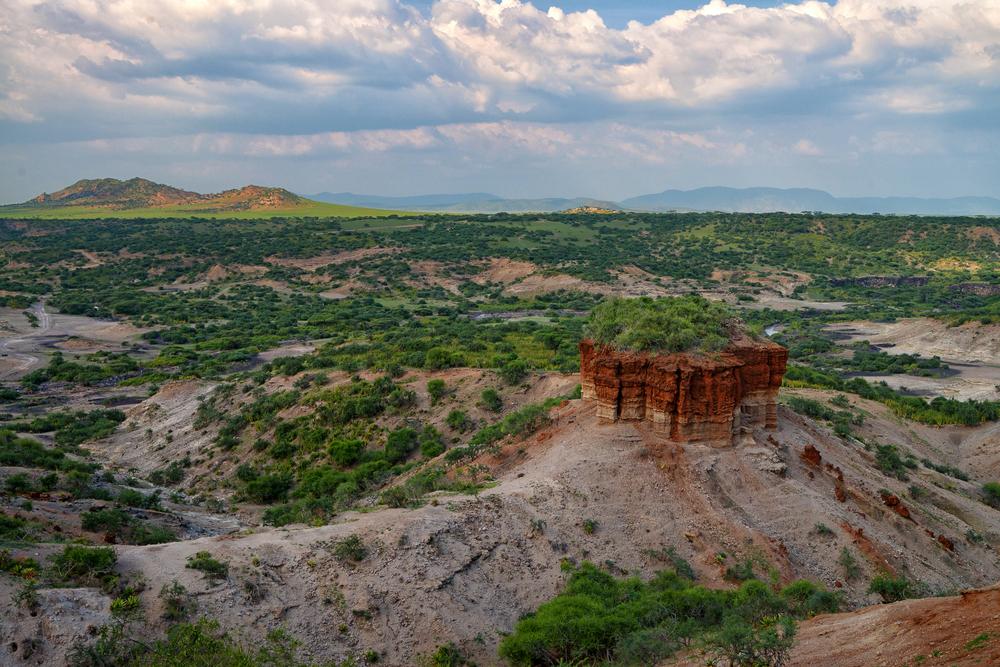
Olduwai Gorge, within the Ngorongoro Conservation Area, has yielded hominid fossils nearly two million years old.
Olduwai Gorge opens across the Serengeti plains, east of the Ngorongoro Conservation Area. This ravine, stretching some fifty kilometers long, has revealed some of the oldest human fossils ever discovered. For anyone interested in the origins of humanity, this site deserves a dedicated visit—far more than a simple safari detour.
Quick Reference Guide
Admission: fee-based, included in Ngorongoro Conservation Area (NCA) access fees; an additional site-specific entrance fee usually applies
Access: 4×4 vehicle only; track connects the main Arusha–Serengeti road to the site museum
Recommended duration: 1.5 to 2 hours (museum visit + gorge viewpoint)
Attire: closed-toe shoes recommended for descending into the ravine
Guided visits: an NCA-accredited local guide is mandatory for descending into the gorge
What You'll See
The site comprises an open-air museum and a viewpoint overlooking the ravine. The geological strata visible on the walls tell two million years of history. The museum displays casts of skulls and stone tools, including Acheulean hand axes, as well as reconstructions of the hominids discovered here.
Descending into the gorge with a guide, you walk along the sedimentary layers where Louis and Mary Leakey uncovered Zinjanthropus boisei (now Paranthropus boisei) in 1959, then remains of Homo habilis. Fossil fauna—giant elephants, multi-horned giraffes—is also represented.
History and Context
Serious excavations began in the 1930s under Louis Leakey's direction. It was Mary Leakey who, in 1959, identified the skull of Paranthropus boisei, approximately 1.75 million years old. The discovery thrust Olduwai onto the world scientific stage and redefined the timeline of human evolution.
The name "Olduwai" derives from the Maasai word oldupai, referring to a wild plant that grows in the ravine. The spelling "Olduwai" is the official Swahili form adopted by Tanzania.
Highlights of Your Visit
The Site Museum
Small yet densely packed, it presents major discoveries in stratigraphic context. Panels explain how geological layers—numbered Bed I through Bed IV—correspond to distinct periods of human evolution. Local guides effectively supplement the display text.
The Gorge Viewpoint
From the constructed overlook, views plunge into the ravine and its colored walls—ochre, gray, red—layered by strata. On clear days, the Ngorongoro crater is visible on the horizon. Here, the geological dimension of the site becomes fully apparent.
Descent into the Ravine
With an accredited guide, you can descend to the excavation zones. You approach the outcrops where bones were discovered. The experience is understated, without theatrical staging, which strengthens its authentic character.
Photography Tips
Morning light, before 10 a.m., accentuates the contrast between gorge strata. From the viewpoint, a wide-angle lens captures the full expanse of the ravine. Inside the museum, lighting is dim: a fast lens or high ISO sensitivity proves useful. Guides typically permit photography in the gorge, but confirm on-site.
Location and Access
Olduwai Gorge lies within the Ngorongoro Conservation Area (NCA), roughly 50 km west of Ngorongoro crater and midway along the route to the Serengeti. From Arusha, allow approximately four hours by 4×4. The site integrates naturally into a circuit combining Ngorongoro crater and the Serengeti.
No public transport reaches the site. A safari vehicle with driver-guide is essential. Wheelchair access to the museum and viewpoint is possible; descent into the gorge is not.
Nearby Attractions
Ngorongoro Crater — volcanic caldera harboring dense wildlife, approximately 50 km to the east.
Serengeti National Park — the great wildebeest migration passes nearby; the Naabi Hill entrance gate is less than an hour away.
Laetoli — paleoanthropological site where Mary Leakey discovered 3.6-million-year-old hominid footprints, within the same NCA zone.
Frequently asked questions
An NCA-accredited guide is mandatory for descending into the ravine. For the museum and viewpoint, your safari driver-guide is typically sufficient.
The site is accessible year-round. The dry season (June–October) eases track travel and provides better visibility in the gorge. During the rainy season (March–May), some tracks may become impassable.
Yes, this is the most common itinerary. An Olduwai visit takes roughly two hours and fits easily between a crater descent in the morning and the drive to the Serengeti in the afternoon.
Photography is generally allowed across the entire site, including in the gorge. Confirm with your guide on-site, as regulations may change.
The museum suits all ages. The gorge descent involves walking on uneven terrain; it is not recommended for very young children or persons with reduced mobility.
"Olduwai" is the official Swahili spelling adopted by Tanzania. "Olduvai" remains the most widespread international spelling in scientific literature. Both refer to the same site.
Want to discover this destination?
Our local advisors design your tailor-made trip.