Kiwengwa Forest
Kiwengwa Forest
Zanzibar's second largest forest, the Kiwengwa-Pongwe reserve is home to caves steeped in history, over 100 plant species and diverse wildlife.
The Kiwengwa-Pongwe forest reserve is the second largest natural forest in the Zanzibar archipelago, after the Jozani Chwaka Bay National Park. Located in the northeast of the island, between Kiwengwa and Uroa beaches, it covers just over 30 km² of dry forest perched on ancient fossilized coral reefs. Beyond its biodiversity, the site is home to the Kiwengwa Caves, a network of caverns steeped in history.
Why visit Kiwengwa Forest
The forest offers a striking contrast to visitors staying on Zanzibar's east coast: just kilometres from the beaches, the landscape shifts dramatically to reveal dense vegetation, limestone caves and wildlife rarely seen on the shoreline. It is one of the few protected forest zones in the archipelago, classified as a reserve in the early 2000s to curb degradation that began in the 1970s (charcoal production, lime extraction, hunting, stone quarrying).
A visit works well as a half-day excursion combined with Kiwengwa Beach, accessible on foot or a few minutes' drive away.
History of the site and caves
In the 1960s-1970s, the Kiwengwa-Pongwe forest remained relatively pristine and was exploited by local inhabitants for domestic use. Later commercial pressure (charcoal production, unregulated extraction) led to its designation as a protected reserve in the early 2000s, the second largest natural forest in the archipelago after Jozani.
The Kiwengwa Caves, officially revealed in 2002, bear traces of much older uses. The caves initially served ancestor worship practices among island dwellers. Later, affluent inhabitants kept leopards in captivity here. During Zanzibar's slave trade era, the caves also served as temporary detention for enslaved people awaiting transfer to the Middle East. Visits are conducted by torchlight, accompanied by a local guide.
What to see in the reserve
Distinctive geology
The forest rests on coral rag rock (coral limestone), formed from dead corals dating back several million years. This rocky base, perforated and well-draining, shapes the vegetation: drought-resistant trees, poor soils, and the formation of underground cavities such as the Kiwengwa Caves.
Flora and medicinal plants
The reserve is home to over 100 plant species, many of them medicinal plants still used by Zanzibaris and Tanzanians. The forest's perimeter is dotted with spice plantations, which have made Zanzibar's reputation (cloves, cinnamon, cardamom, vanilla).
Birds and mammals
The site is a recognized birdwatching point, with around forty species recorded, among them:
- the Zanzibar dark-capped bulbul,
- the white-browed coucal,
- Fischer's turaco,
- the crowned hornbill.
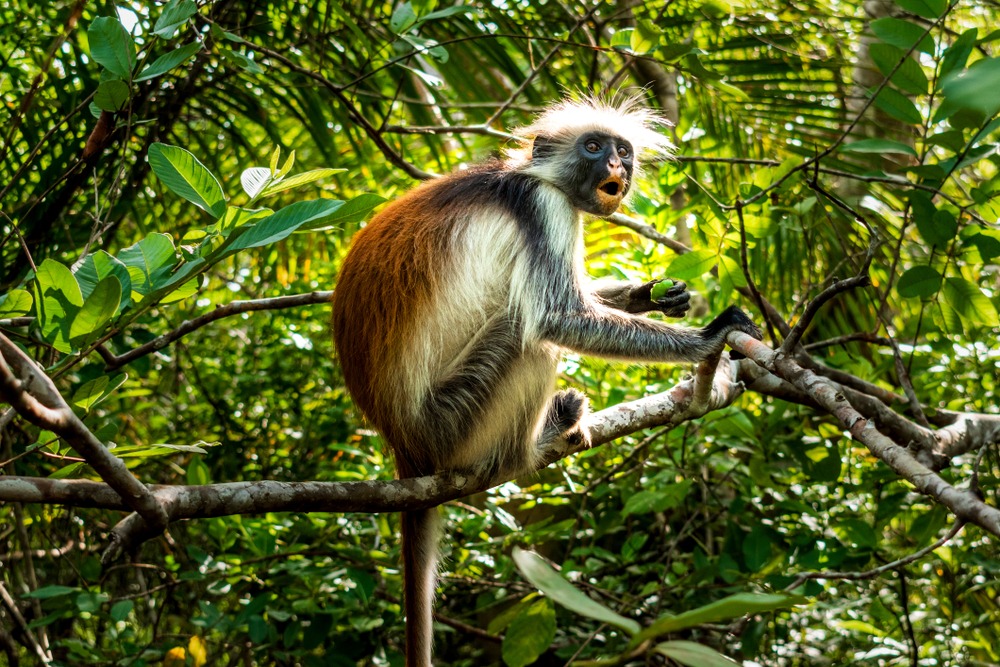
As for mammals, you may encounter blue monkeys, red colobus, Ader's duiker and antelope. The forest is also home to several snake species: following your guide is essential.
Practical information
Visits must be made with a local guide, particularly for exploring the caves (torch provided or bring your own). Allow around 1.5 to 2 hours for a typical forest and cave loop, longer if you add a birdwatching session. Modest fees paid on site; bring Tanzanian shilling notes.
Closed-toe hiking shoes, water, insect repellent and long-sleeved clothing are recommended.
When to visit
Zanzibar enjoys an equatorial climate, with temperatures between 22 °C and 26 °C. The rainy season spans March to May, the dry season June to October. The best windows for visiting the reserve are July-September and November-February, when trails are passable and humidity manageable.
How to get there
The reserve is about 45 km from Zanzibar Town (Stone Town), or 1 to 1.5 hours' drive depending on traffic. Three options:
- Private taxi or transfer from Stone Town or the airport, the simplest option.
- From your hotel in Kiwengwa or Uroa, access is immediate: the road linking Kiwengwa to Upenja runs through the area.
- Dala-dala (local minibuses) from Stone Town to Kiwengwa, then taxi or walk to the entrance — more economical but longer.
The reserve is bordered to the north by the villages of Kandwi and Pwani Mchangani, and to the west by the Zanziflora conservation zone.
What to combine nearby
Kiwengwa Beach
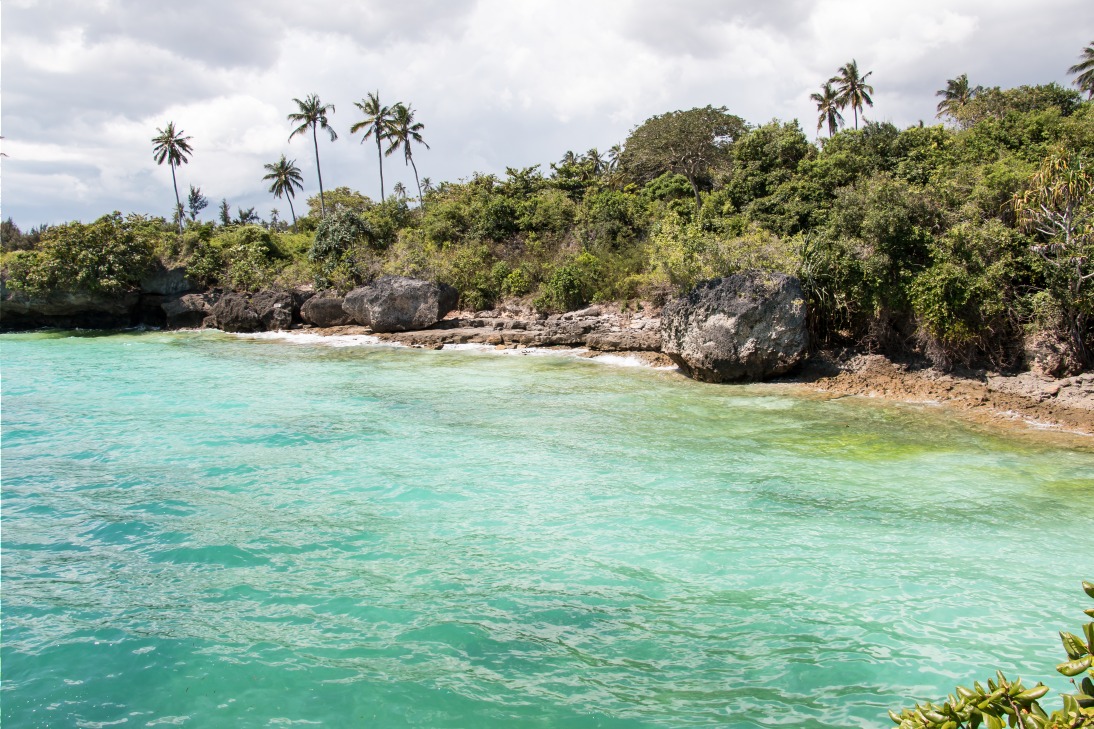
Clear sand, shallow lagoon and coconut palms: Kiwengwa Beach is ideal for ending a morning in the forest. At low tide, natural pools form, offering opportunities to observe small marine life. Snorkeling, paddling and swimming are all possible in calm conditions.
Mnemba Island
A private island less than 3 km offshore, surrounded by a marine reserve. The reef is home to abundant marine life (tropical fish, turtles, dolphins depending on season) and is one of Zanzibar's most renowned snorkeling spots. Half-day boat excursions are organized regularly.
Matemwe village
North of Kiwengwa, Matemwe stretches one of the island's longest beaches, edged by a lagoon protected by a reef. The atmosphere here is more authentic, shaped by traditional fishing and subsistence farming.
Frequently asked questions
Frequently asked questions
Yes, access to the Kiwengwa Caves is only possible with a local guide equipped with a torch. For the forest itself, a guide remains highly recommended: it facilitates bird and mammal spotting and allows you to understand the use of medicinal plants.
The entrance fee remains modest and typically includes a guide. Prices do change: check with your accommodation or a local agency, and bring Tanzanian shilling notes, as payment is made on site.
Yes, this is actually the most common option. The reserve borders Kiwengwa Beach directly: a 2-hour morning visit leaves the afternoon free for swimming or an excursion to Mnemba Island.
Plan your stay
Kiwengwa Forest fits easily into a broader itinerary combining Stone Town, east coast beaches and mainland safari. To plan your route, explore our Tanzanie travel ideas.
Interested in this visit?
We can include it in your personalised itinerary.